
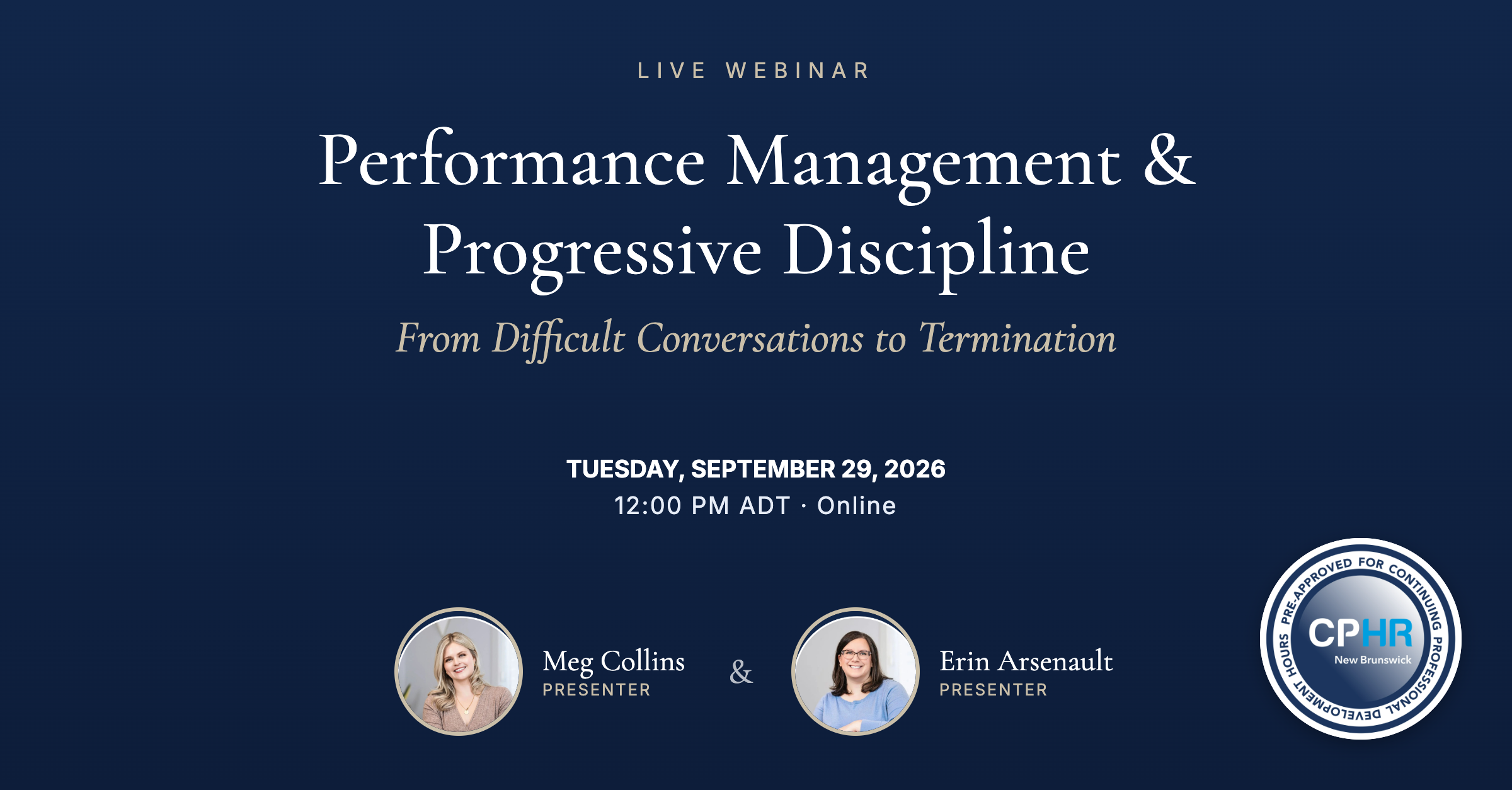
Performance Management and Progressive Discipline: Resonance HR Law Webinar, September 29, 2026
Managing employee performance is one of the most consequential responsibilities facing employers and HR professionals. Getting it wrong is costly. Getting it right requires knowing both the legal framework and the practical process. This workshop covers both.

The Investigation Report Is Not the End: What Workplace Restoration Actually Requires
The file closes. The findings are made. Discipline is applied. And on Monday morning, the same people are expected to work together in the same building. Most employers stop at discipline and call it resolved. Workplace restoration is what determines whether they are right.

Undue Hardship: What It Actually Means for Atlantic Canada Employers
Undue hardship is not the same as inconvenient. It is not the same as expensive. It is not the same as complicated. It is a legal threshold, and most employers who lose accommodation cases did not refuse outright. They simply never ran the process the law requires.

Nova Scotia Workers' Compensation: The Two-Day Reporting Rule Is Already in Force
Nova Scotia employers now have two days to report a workplace injury to WCB — not five. That change took effect January 1, 2026. If your incident reporting process has not been updated to match it, the next injury claim will find that out for you.
NB Pay Transparency Act: What Employers Must Do Now
New Brunswick's Pay Transparency Act received Royal Assent on June 12, 2026. Some obligations are already in force. The employers who will struggle most are the ones treating this as a future project.

NS & PEI Minimum Wage: October 2026 Employer Guide
Nova Scotia's minimum wage rises to $17.00 an hour on October 1, 2026. PEI hits $17.30 the same day. Both increases are formula-driven and will compound annually. Here is what Atlantic Canada employers need to do before the effective date.


After the Investigation Is Over: What Workplace Restoration Actually Requires
Completing a workplace investigation is not the end of the employer's obligations. What happens next — to the people, the team, and the organization's systems — determines whether the situation is genuinely resolved or simply documented.

The Cost of Guessing: Why Ambiguous Workplace Situations Require a Structured Response
Is this a performance issue or misconduct? Is this a conflict or a complaint? Managers guess at these questions every day. The legal exposure comes when the guess turns out to be wrong.

Why Workplace Decisions Are Political (and What That Means When Things Go Wrong)
Discipline, promotions, complaints, and resource decisions are rarely made in a vacuum. They are made by people, in organizations, with competing priorities, relationships, and influence. Understanding that reality is what allows employers to navigate it safely.

Why Your Workplace Policies Are Probably Overdue for a Review
Your policies tell people what someone in your organization is supposed to do. The question is whether they still reflect how your organization actually works, what the law currently requires, and who you want to be as an employer.

The 360-Degree Feedback Process: What It Is, How It Works, and What Employers Need to Know in 2026
Used well, 360-degree feedback is one of the most powerful tools available for developing people and strengthening organizational culture. Used poorly, it erodes trust, exhausts employees, and produces data that sits on a shelf. Here is how to get it right.

AI in the Boardroom: What Directors and HR Leaders Need to Know
Directors are not expected to become AI experts. They are, however, expected to govern AI with the same rigour they bring to financial oversight, cybersecurity, and organizational risk. Here is what that means in practice.

Fired mid-accommodation: What Shaikh v Colliers teaches every employer
A new BCHRT ruling draws a hard line around a dangerously common fact pattern — the employee who discloses a disability after performance concerns are already on the table, then gets terminated before accommodation is complete.

Investigating Senior Leadership: Ensuring Fairness and Protecting Organizational Integrity
Learn how to conduct fair, independent investigations involving executives, senior leaders, CEOs, or board members. Resonance HR Law helps organizations protect integrity, manage risk, and maintain trust through impartial workplace investigation processes.

HR Compliance for Growing Businesses – From First Hire to Scalable Processes
Small and medium-sized businesses face unique HR challenges as they grow — from creating their first employment contracts to developing policies that keep pace with expansion. This article outlines the key HR legal essentials every employer needs to stay compliant, mitigate risk, and build scalable people processes that support growth with confidence.

Mediation or Investigation: Choosing the Right Path to Workplace Resolution
When workplace conflict arises, choosing between mediation and investigation is critical. This article explains how Canadian employers can assess the nature of an issue, determine the appropriate resolution process, and ensure fairness, neutrality, and compliance. It outlines key differences, legal considerations, and best practices to help organizations resolve conflict effectively while protecting trust and credibility.

Performance Management Through a Legal Lens: Ensuring Fairness and Compliance
Performance management is one of the most important, and legally sensitive, responsibilities for employers. This article explains how Canadian organizations can manage performance, promotions, and discipline through a fair, structured, and legally compliant framework. By aligning HR practices with employment and human rights law, employers can reduce risk while fostering accountability, transparency, and employee growth.

Board Governance in Action: How Effective Governance Strengthens Accountability and Culture
Explore how effective board governance, policy development, and accountability frameworks reduce organizational risk, strengthen culture, and align leadership across non profit, public, and corporate sectors.

HR Legal Audits for Canadian Employers: A Comprehensive Compliance Guide
Canadian employers face complex and evolving compliance requirements under federal and provincial employment standards, human rights laws, and workplace safety regulations. This article provides a practical, step-by-step framework for conducting an HR legal audit that helps identify risks, align HR policies with the law, and ensure proper documentation and recordkeeping across your organization.